Reload once and note whether the error appears on one page or on unrelated sites too.
Likely causes to check first
- one extension or profile is misbehaving
- cached site data is stale
- memory pressure is forcing tabs to reload
- DNS/network problems affect only some sites
- security software or a proxy is intercepting connections
Troubleshoot from low-risk to high-risk
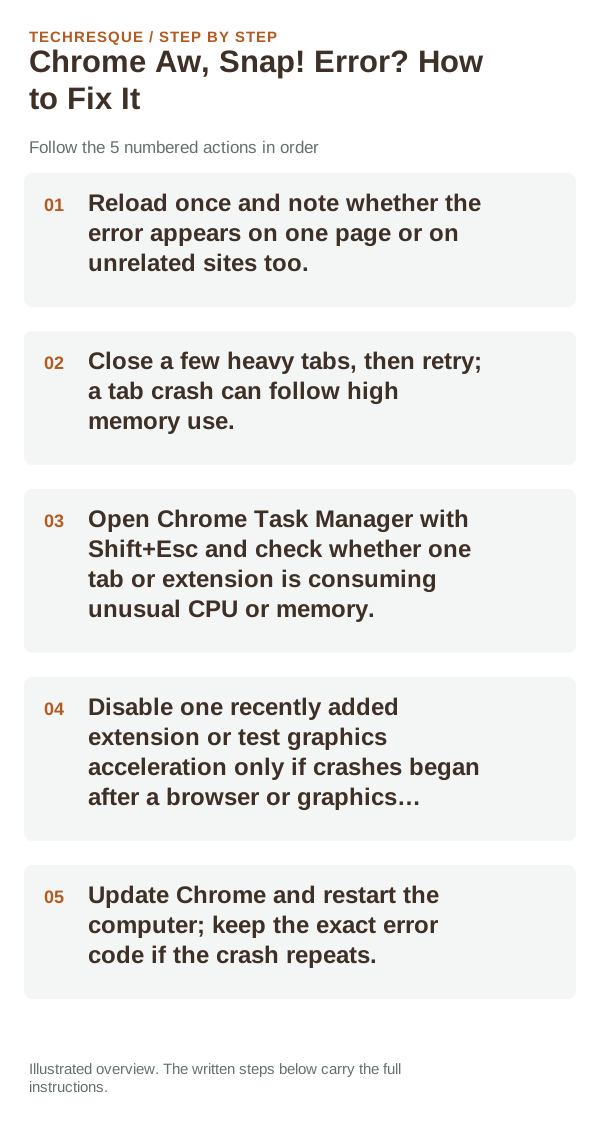
- Reload once and note whether the error appears on one page or on unrelated sites too.
- Close a few heavy tabs, then retry; a tab crash can follow high memory use.
- Open Chrome Task Manager with Shift+Esc and check whether one tab or extension is consuming unusual CPU or memory.
- Disable one recently added extension or test graphics acceleration only if crashes began after a browser or graphics update.
- Update Chrome and restart the computer; keep the exact error code if the crash repeats.
What each result tells you
One site crashing while other tabs remain stable points toward that page or its content. If unrelated sites crash, check memory pressure, extensions, Chrome updates, and graphics acceleration one at a time. The error code shown beside “Aw, Snap!” can distinguish a tab crash from a network failure.
How to confirm the fix
Reload the page that showed Aw, Snap! and use Chrome normally for several minutes. If it returns, try a second site to see whether the crash follows one page or the whole browser.
When to use support or repair
If the same page fails in another browser, contact the site or network owner; if only Chrome fails, report its version and reproduction steps.
Record Chrome version, device/OS, profile and extension state, and the affected page without private tokens or account data.
Distinguish a site problem from a browser-wide problem
Incognito or a fresh profile is useful as a diagnostic because it changes extension and stored-site-data conditions without immediately deleting your normal profile. Treat it as a test, not automatically as the permanent fix.
For camera, microphone, notifications and pop-ups, Chrome has per-site permissions in addition to the operating system’s privacy controls. Both layers must allow the feature.
If one website fails while others load, start with that site’s permissions, cookies, extensions and server availability. If many unrelated sites fail, investigate Chrome itself, the device network or system-level security software.
| What you observe | What it points to | Best next check |
|---|---|---|
| One site fails | Site data, permission, extension or site outage | Test another site and an incognito window |
| All sites fail | Network, browser state or security software | Check connection and restart Chrome |
| Feature works outside Chrome | Chrome site permission or selected device | Review Site settings and OS permission |
Frequently asked questions
What should I check first for chrome aw, snap! error? how to fix it?
Reload the tab once, then close other heavy tabs/extensions and restart Chrome. If only one site fails, test that site in Incognito and another browser before reinstalling Chrome.
Should I reset the whole device immediately?
Usually not. Compare a private window and another browser first. Reset Chrome only after checking the profile, extensions and sync.
How do I know when the fix is real?
Reload the page that showed Aw, Snap! and use Chrome normally for several minutes. If it returns, try a second site to see whether the crash follows one page or the whole browser.
Official sources and further reading
Use the exact Chrome error code to narrow the cause. Never bypass a certificate warning for sensitive sites.