Put the accessory back into pairing mode, keep it close, remove the saved device from Windows and pair again. Then run the Bluetooth troubleshooter and update drivers.
Start with the simplest reversible checks before moving to resets or repair.
Why this happens
Do not assume the most expensive failure first. This problem usually becomes much easier once you separate a settings problem from a connection, app, accessory or hardware problem.
- The accessory is not in pairing mode.
- It is already connected to another host.
- Battery is low or the device is out of range.
- A stale saved pairing is blocking a clean connection.
- The Windows Bluetooth driver/service is unstable.
Fix it in this order
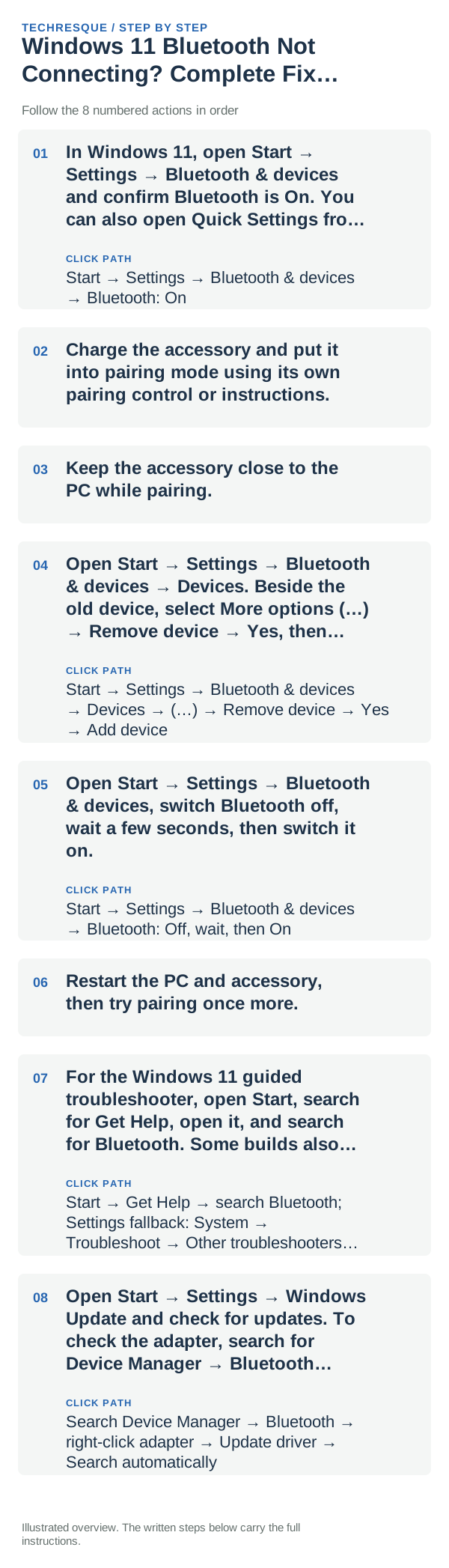
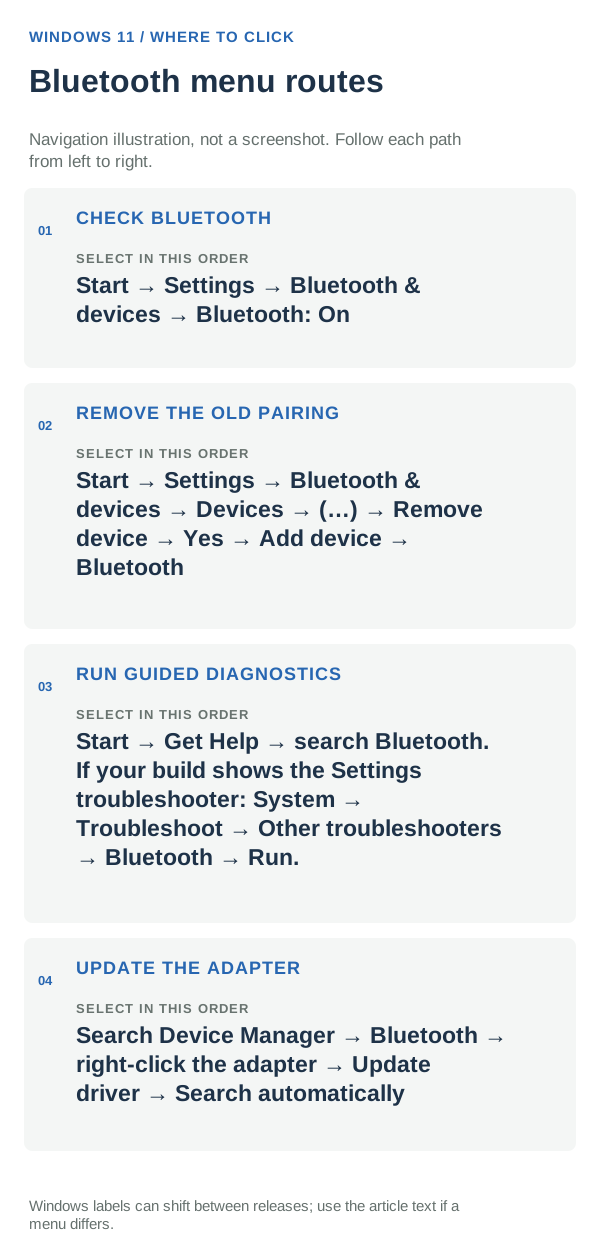
- In Windows 11, open Start → Settings → Bluetooth & devices and confirm Bluetooth is On. You can also open Quick Settings from the taskbar’s network, sound, or battery icon and select Bluetooth.
- Charge the accessory and put it into pairing mode using its own pairing control or instructions.
- Keep the accessory close to the PC while pairing.
- Open Start → Settings → Bluetooth & devices → Devices. Beside the old device, select More options (…) → Remove device → Yes, then choose Add device → Bluetooth and pair it again.
- Open Start → Settings → Bluetooth & devices, switch Bluetooth off, wait a few seconds, then switch it on.
- Restart the PC and accessory, then try pairing once more.
- For the Windows 11 guided troubleshooter, open Start, search for Get Help, open it, and search for Bluetooth. Some builds also show Start → Settings → System → Troubleshoot → Other troubleshooters → Bluetooth → Run.
- Open Start → Settings → Windows Update and check for updates. To check the adapter, search for Device Manager → Bluetooth, right-click the adapter, and select Update driver → Search automatically. If Windows finds nothing, use the PC maker’s support page.
How to identify the real cause
If the accessory never appears during Add device, focus on pairing mode, battery and radio range. If it appears but fails to connect, remove old pairings and check drivers.
Common mistakes that waste time
- Trying to pair while the accessory remains connected to a phone.
- Leaving the accessory out of pairing mode.
- Installing third-party driver-updater utilities.
- Resetting Windows network settings for a Bluetooth-only problem before basic pairing steps.
When this is probably not a settings problem
Test the accessory with another computer and test another Bluetooth accessory with this PC. That cross-test quickly identifies which side needs support.
If you need repair or manufacturer support, write down what you already tested. A short list of known-good cables, devices, networks or apps you tried is much more useful than saying only that the feature “doesn't work.”
Remove ambiguity with cross-testing
Pair the accessory to another PC or phone, and pair a different accessory to this Windows PC. The test tells you whether the fault follows the accessory or the computer. That is much more useful than repeatedly deleting the same pairing.
Interference can be surprisingly local
Microsoft notes that some unshielded USB 3.0 devices can interfere with Bluetooth. If problems happen only beside a USB drive, dock or adapter, move that device away or temporarily disconnect it during testing.
Once one step appears to work, stop and reproduce the original problem under the same conditions. If it stays fixed, leave unrelated settings alone. That preserves a clear cause-and-effect trail and avoids creating a second problem while trying to solve the first.
If the symptom returns, write down the trigger, time, network, battery level, connected accessories and app in use. Those details make the next diagnostic step much more precise and are useful if you eventually need manufacturer or developer support.
Frequently asked questions
Why is my Bluetooth device visible but not connecting?
A stale pairing, low battery, existing connection to another host or driver problem can cause this.
Should I remove the device and pair again?
Yes. Microsoft recommends re-pairing when saved connections fail.
Can USB 3 devices interfere with Bluetooth?
Microsoft notes that some unshielded USB devices near USB 3.0 ports can interfere with Bluetooth.
Do I need new Bluetooth drivers?
Update them if basic pairing and restarts do not solve the problem.