Large scanned pages, high-resolution images or a sluggish viewer can delay opening. Download the file, try another trusted viewer, and check whether the slowdown follows the PDF or the app.
What matters most
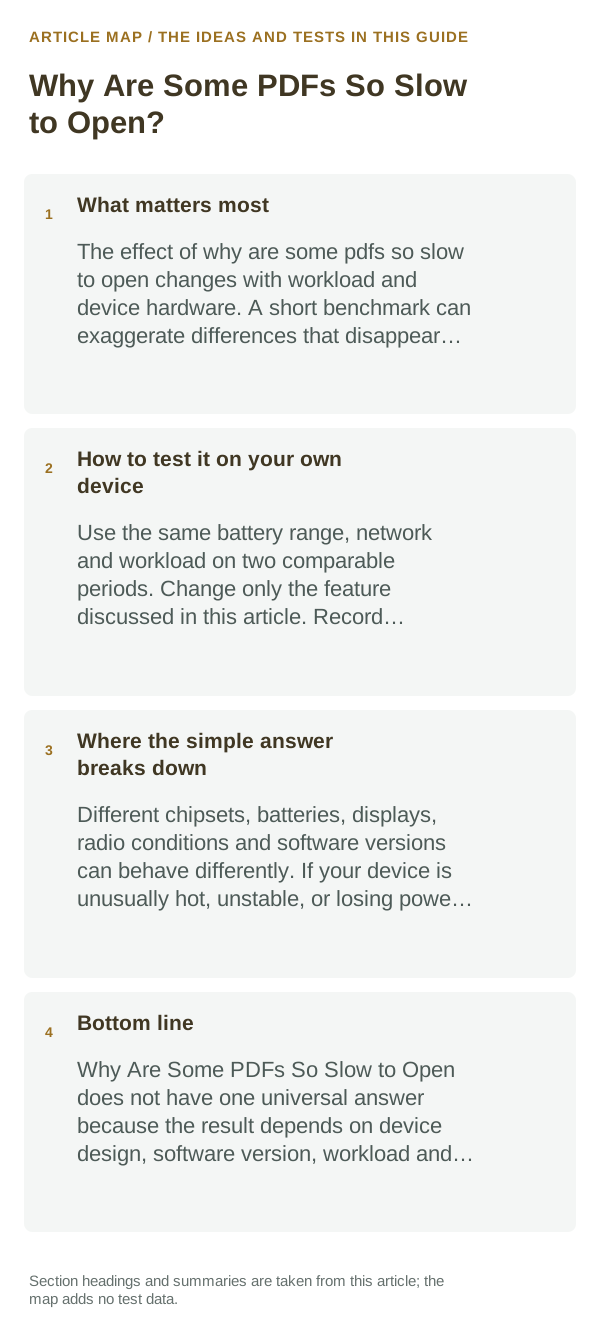
If one file is slow in several viewers, its size or structure is a stronger lead; if only one app struggles, update or troubleshoot that viewer.
What I would change first
- Change only the setting directly related to why are some pdfs so slow to open and observe the result.
- Use the device normally for long enough to see a pattern, not a five-minute snapshot.
- Prefer the platform’s built-in controls over third-party “optimizer” apps.
- Restore the original setting if the change makes the device less useful without a measurable benefit.
How to test it on your own device
Use the same battery range, network and workload on two comparable periods. Change only the feature discussed in this article. Record screen-on time, idle drain or the specific behavior you care about. One controlled comparison is more useful than several settings changed together.
Where the simple answer breaks down
Different chipsets, batteries, displays, radio conditions and software versions can behave differently. If your device is unusually hot, unstable, or losing power rapidly while idle, troubleshoot that underlying problem instead of treating why are some pdfs so slow to open as the sole cause.
Bottom line
Download the file and open it in another trusted viewer. If both viewers struggle with the same document, inspect its size and structure before editing a copy.
Readream fits naturally here
an offline Android EPUB and PDF reader with local library management, reading progress, search, bookmarks, highlights, notes, adjustable reading layout and offline text-to-speech. Its Play listing states no ads, no registration and no developer-operated analytics.
View Readream on Google Play →Match the document format to the job you are doing
PDF is designed to preserve page layout, while EPUB is designed to reflow text to the reader’s screen. That difference affects zooming, annotations, text-to-speech and how comfortable long reading sessions feel on a phone.
For editing or conversion, keep an untouched copy before changing pages, compression or signatures. A visually successful edit can still alter searchable text, form fields or image quality in ways that only appear later.
When comparing reader apps, test the same real file. Large PDFs, scanned documents and complex EPUB books can expose performance or rendering differences that a simple sample book will not.
| What you observe | What it points to | Best next check |
|---|---|---|
| Exact page layout matters | Fixed-layout document workflow | Prefer PDF and verify zoom/readability |
| Editing/signing is the goal | Document tool compatibility | Test on a copy and verify the saved output |
| Text should resize to screen | Reflowable ebook workflow | Prefer EPUB where the source supports it |
Frequently asked questions
Is there one rule that applies to every phone?
No. Hardware, software, temperature, signal and workload can change the result.
What is the best way to test this?
Compare two similar periods while changing only one setting or behavior.
Should I install an optimizer app?
Usually not as a first step. Built-in battery and performance tools give cleaner evidence and avoid adding another background process.
Official sources and further reading
Reader controls and sync options depend on the app and file type. Test the same file in another reader before changing the original.