Android reuses RAM as needed; a cleaner that force-closes apps does not add memory and may make them load again. Check storage, recent app updates and heat if lag remains.
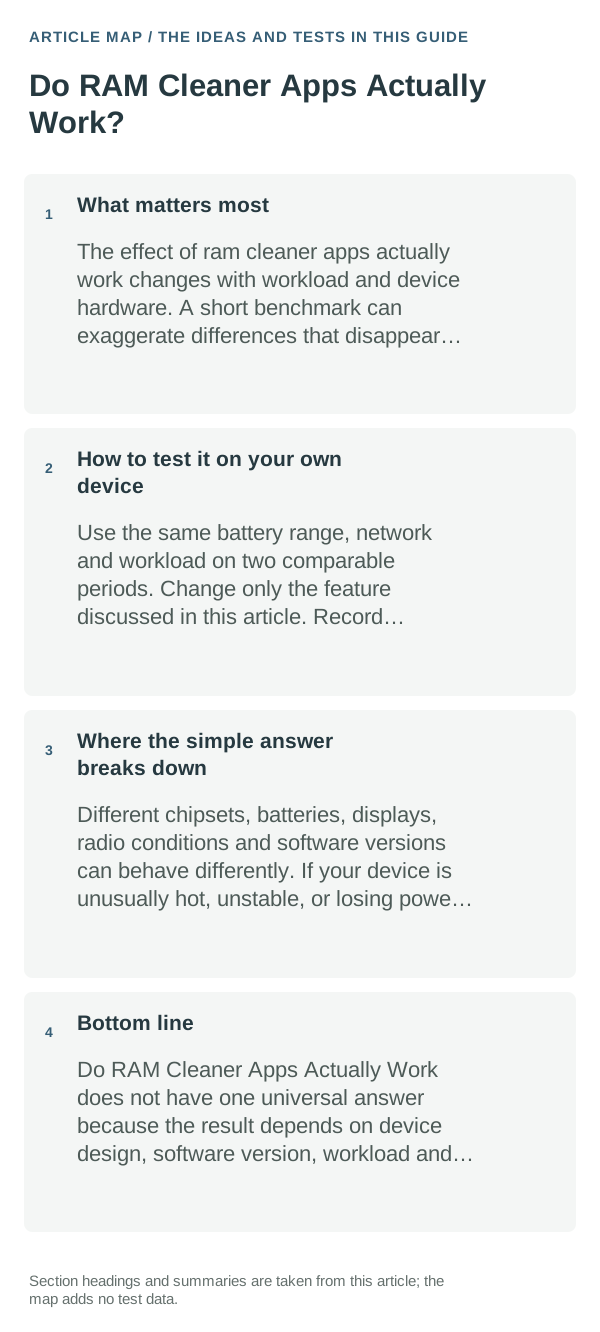
What matters most
Memory marked as occupied is not automatically wasted. Android can keep useful app data ready until another task needs that space.
What I would change first
- Change only the setting directly related to ram cleaner apps actually work and observe the result.
- Use the device normally for long enough to see a pattern, not a five-minute snapshot.
- Prefer the platform’s built-in controls over third-party “optimizer” apps.
- Restore the original setting if the change makes the device less useful without a measurable benefit.
How to test it on your own device
Use the same battery range, network and workload on two comparable periods. Change only the feature discussed in this article. Record screen-on time, idle drain or the specific behavior you care about. One controlled comparison is more useful than several settings changed together.
Where the simple answer breaks down
Different chipsets, batteries, displays, radio conditions and software versions can behave differently. If your device is unusually hot, unstable, or losing power rapidly while idle, troubleshoot that underlying problem instead of treating ram cleaner apps actually work as the sole cause.
Bottom line
Leave Android to manage memory. If one app keeps stalling, check that app’s update and settings instead of clearing every background process.
Use a controlled test instead of changing several settings at once
Android manages app memory automatically. Close an app only when it is stuck or you need to stop a specific task; repeatedly clearing memory can make apps reload and may increase work.
Compare one ordinary task before and after the change, such as opening the same app or scrolling the same screen. Check free storage and the phone's own battery/performance view before attributing a slowdown to memory.
If the phone remains slow after a restart and a matched comparison, check storage, system updates, and the app that is actually consuming resources. A factory reset is not a routine performance tune-up.
| What you observe | What it points to | Best next check |
|---|---|---|
| Known-good alternative works | Original component likely involved | Replace/reconfigure that component |
| No change after reversible checks | Deeper system or service issue | Escalate with test results documented |
| Only one app/device fails | Local configuration or hardware path | Keep troubleshooting scoped locally |
Frequently asked questions
Is there one rule that applies to every phone?
No. Hardware, software, temperature, signal and workload can change the result.
What is the best way to test this?
Compare two similar periods while changing only one setting or behavior.
Should I install an optimizer app?
Usually not as a first step. Built-in battery and performance tools give cleaner evidence and avoid adding another background process.
Official sources and further reading
Repeat the same action after one change, and note the result.