Disconnect the accessory from other devices, forget the pairing on both sides, pair again, then confirm the correct audio/input profile is selected.
On iPhone, prefer Apple’s built-in Settings and reset options; use “Reset All Settings” or a full erase only when a narrower fix has failed and you have a backup.
Why this can happen
- the accessory is still connected to another device
- the pairing record is stale on one side
- the device profile required for audio, calls or input is not active
- distance or 2.4 GHz interference is causing drops
- a driver, firmware or OS update changed Bluetooth behavior
Troubleshoot from low-risk to high-risk
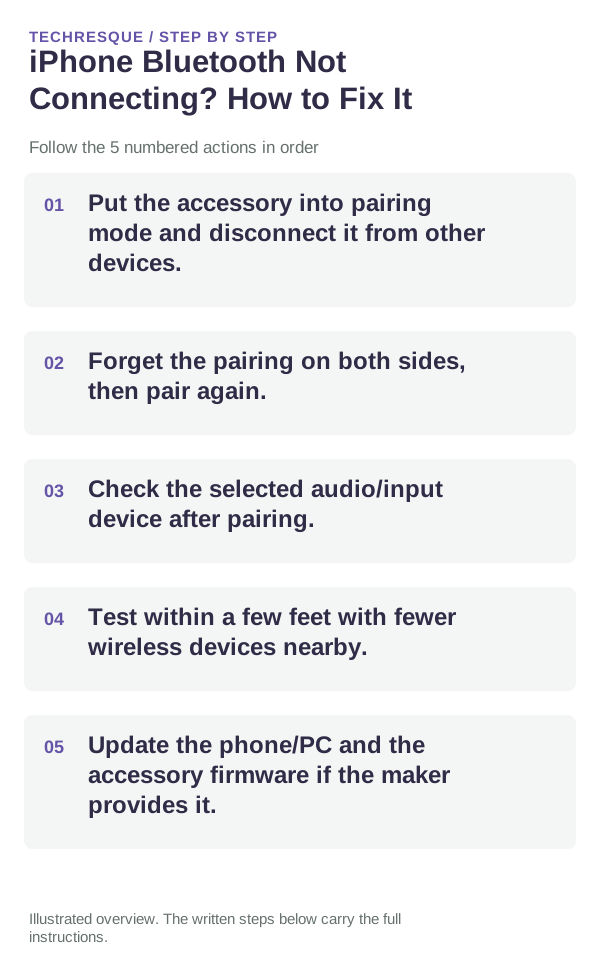
- Put the accessory into pairing mode and disconnect it from other devices.
- Forget the pairing on both sides, then pair again.
- Check the selected audio/input device after pairing.
- Test within a few feet with fewer wireless devices nearby.
- Update the phone/PC and the accessory firmware if the maker provides it.
Use a clean A/B test
Compare pairing, media playback and microphone/call use separately. Bluetooth can connect successfully while the wrong profile or output device is selected, so “Connected” is not the same as “working for this feature.”
Repeat the same action in the same iPhone app after one change. Check another app before resetting network or privacy settings.
Changes to avoid until you know the cause
- Do not keep the accessory actively connected to another phone while pairing.
- Do not reset all network settings before forgetting one problematic pairing.
- Do not treat “paired” as proof that the correct audio/microphone profile is active.
- Do not troubleshoot from several rooms away or through heavy interference.
What success should look like
Test the exact profile that failed: music audio, call microphone, keyboard input or file transfer.
When to use support or repair
If multiple known-good Bluetooth accessories fail only with one device after updates and re-pairing, use the device maker’s support path. If only one accessory fails everywhere, focus on that accessory.
Record iPhone model, iOS version, affected app or setting, exact message and whether it follows one network. Hide personal details in screenshots.
Pairing and audio are separate tests
First prove that the devices can pair. Then prove that the intended profile—media, calls, microphone or input—works. Solving the wrong layer is why many Bluetooth fixes appear inconsistent.
Frequently asked questions
What should I check first for iphone bluetooth not connecting? how to fix it?
Disconnect the accessory from other devices, forget the pairing on both sides, pair again, then confirm the correct audio/input profile is selected.
Should I reset the whole device immediately?
Usually not. Check the affected app, accessory or setting first. Reset All Settings or erase the phone only after a backup.
How do I know when the fix is real?
Test the exact profile that failed: music audio, call microphone, keyboard input or file transfer.
Official sources and further reading
iPhone settings labels can move between iOS versions. Use Settings search if a path differs, and check whether the symptom affects one app or the whole device.