Yes, a launcher can add animation and widget work, especially on a heavily customized Home screen. Test with a simple layout before blaming it for system-wide lag.
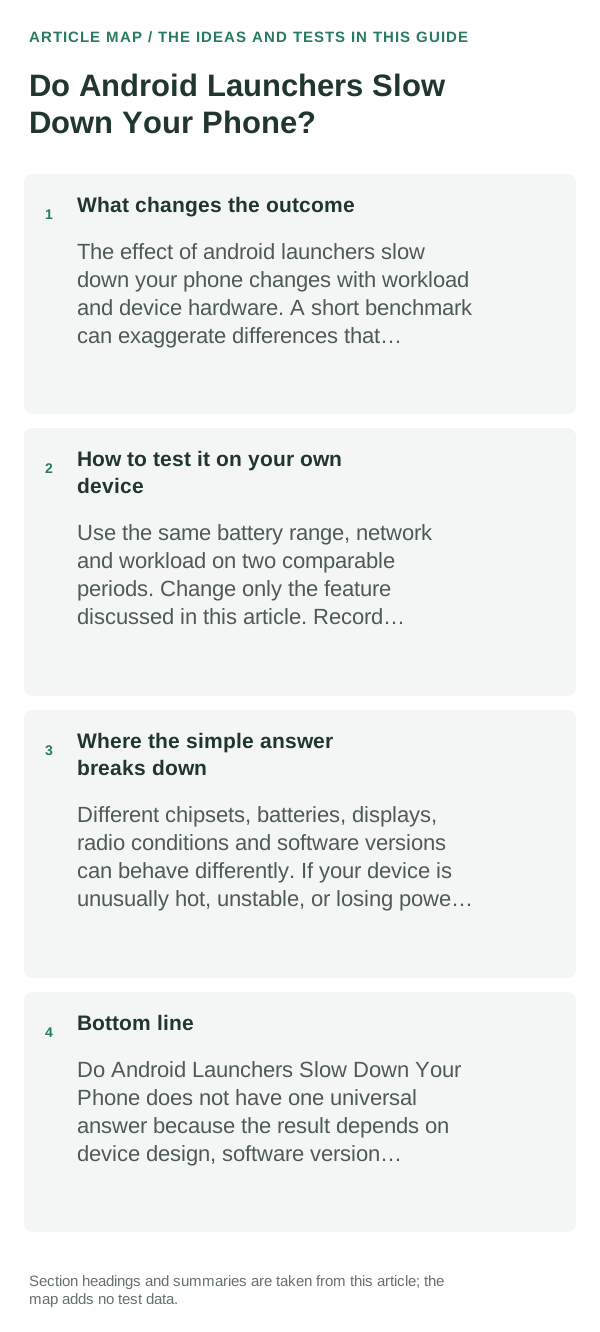
What changes the outcome
Live wallpapers and frequent widget refreshes add more Home-screen work than a mostly static layout; compare before changing system settings.
How to apply this without overthinking it
- Change only the setting directly related to android launchers slow down your phone and observe the result.
- Use the device normally for long enough to see a pattern, not a five-minute snapshot.
- Prefer the platform’s built-in controls over third-party “optimizer” apps.
- Restore the original setting if the change makes the device less useful without a measurable benefit.
How to test it on your own device
Use the same battery range, network and workload on two comparable periods. Change only the feature discussed in this article. Record screen-on time, idle drain or the specific behavior you care about. One controlled comparison is more useful than several settings changed together.
Where the simple answer breaks down
Different chipsets, batteries, displays, radio conditions and software versions can behave differently. If your device is unusually hot, unstable, or losing power rapidly while idle, troubleshoot that underlying problem instead of treating android launchers slow down your phone as the sole cause.
Bottom line
If the default launcher removes the delay, reduce live widgets or animations first. If the phone stays slow, continue with device-level checks.
Hysoft app: Minimalistic: Launcher
For users who want a clean, distraction-light Android Home screen, Minimalistic: Launcher fits naturally here: a focused Android launcher with a clean monochrome Home screen, fast app search, favourites and folders, focus profiles, mindful launch delays, optional app blocking, and local backup. Its Play listing states that it has no advertisements, analytics, trackers, accounts or cloud sync.
View Minimalistic: Launcher on Google Play →Judge the launcher by the home-screen workflow, not screenshots
When comparing launchers, recreate one real home screen rather than judging the default setup. Test search, folders, icon packs, widgets, backup/restore and the gestures you use every day.
If a launcher keeps resetting or widgets disappear, first check whether Android has changed the default Home app, restricted background activity or removed widget permissions after an update.
A launcher mainly controls the home screen and app drawer; it does not replace Android itself. Gesture behavior, recents animations and some widgets can still depend on the phone maker and Android version.
| What you observe | What it points to | Best next check |
|---|---|---|
| Gestures feel different | OEM/Android navigation integration | Test the exact gesture before switching permanently |
| Home button opens another launcher | Default Home app changed | Set the intended launcher as default |
| Widgets stop refreshing | Battery/background restriction or widget host issue | Remove/re-add widget and review restrictions |
Frequently asked questions
Is there one rule that applies to every phone?
No. Hardware, software, temperature, signal and workload can change the result.
What is the best way to test this?
Compare two similar periods while changing only one setting or behavior.
Should I install an optimizer app?
Usually not as a first step. Built-in battery and performance tools give cleaner evidence and avoid adding another background process.
Official sources and further reading
- Lawnchair — Official GitHub repository
- Niagara Launcher — Help center
- Smart Launcher — Official site
- Nova Launcher — Official site
Launcher gesture and widget support depends on the Android version and phone maker. Keep your current launcher until the new layout is stable.