To organize android apps without using folders, make the change in the launcher/home-screen layer first, keep the original setup easy to restore, and test gestures/widgets after each major change.
Home-screen menus and layout options depend on Android version, manufacturer, and active launcher. Confirm the Home app before changing layout or default settings.
Before you start
Before changing the Home screen, capture the current layout or use the launcher's export/backup option. Note the active Home app so you can return to it.
Step-by-step
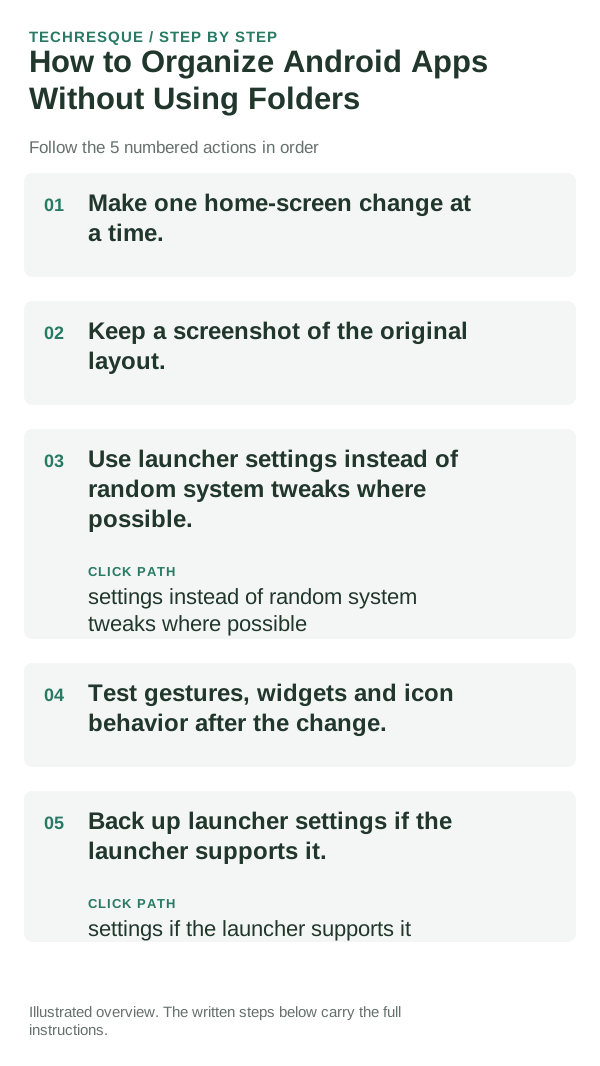
- Make one home-screen change at a time.
- Keep a screenshot of the original layout.
- Use launcher settings instead of random system tweaks where possible.
- Test gestures, widgets and icon behavior after the change.
- Back up launcher settings if the launcher supports it.
How to check the result
Press Home, lock and unlock once, then restart the phone and check the same icons, folders, widgets, grid, and default Home app. Confirm the layout stays as intended.
If the option is missing
Home-screen controls vary by phone brand, Android version, and launcher. Search Settings for Home app or Home screen, and check the launcher's own help before installing a replacement.
Keep the change easy to undo
Keep the previous launcher installed and preserve its layout export until the new arrangement survives a restart. Switch the Default apps > Home app selection back to restore the prior launcher.
What to do if it still fails
If a layout or icon disappears, check the app drawer and active Home app before reinstalling anything. Compare the stock launcher, then restore the saved layout if needed.
Widgets: Pixel Theme
a pixel-inspired widget app with clock, weather, battery, music, photo, app-shortcut, device-information and productivity widgets plus matching wallpapers. Its Play listing states no data is shared or collected. It is most relevant here when the goal is a coordinated Android Home screen rather than a system-level troubleshooting fix.
View Widgets: Pixel Theme on Google Play →Use a controlled test instead of changing several settings at once
Take a layout backup before experimenting. Changing multiple launcher settings at once makes it difficult to identify which one changed spacing or removed an icon.
Change one Home-screen setting at a time, then check the same page and restart once. Keep the original grid or layout export so you can compare and reverse the result.
If the layout stays correct after a restart, keep the working setup and stop changing unrelated icon, grid, and widget options.
| What you observe | What it points to | Best next check |
|---|---|---|
| No change after reversible checks | Deeper system or service issue | Escalate with test results documented |
| Only one app/device fails | Local configuration or hardware path | Keep troubleshooting scoped locally |
| Known-good alternative works | Original component likely involved | Replace/reconfigure that component |
Before you make a bigger change
Before clearing launcher data or removing the old launcher, export its layout and verify the backup can be restored. Clearing launcher storage can erase folders, icon positions, and widgets.
Frequently asked questions
Will this erase my Home-screen layout?
A setting change usually affects only the selected layout option, but clearing launcher data can remove the whole arrangement. Export or capture the layout first.
Why are the Home-screen menus different?
Pixel, Samsung, Xiaomi, OnePlus, and third-party launchers use different labels and features. Search Settings for the named default or layout control and check the launcher's help.
How do I return to the old launcher?
Leave the old launcher installed, then choose it under Settings > Apps > Default apps > Home app. Restore its exported layout if the previous arrangement changed.