Wi-Fi can use less battery than mobile data when the wireless signal is strong, but there is no fixed winner. Weak coverage, switching networks and the data task change the result.
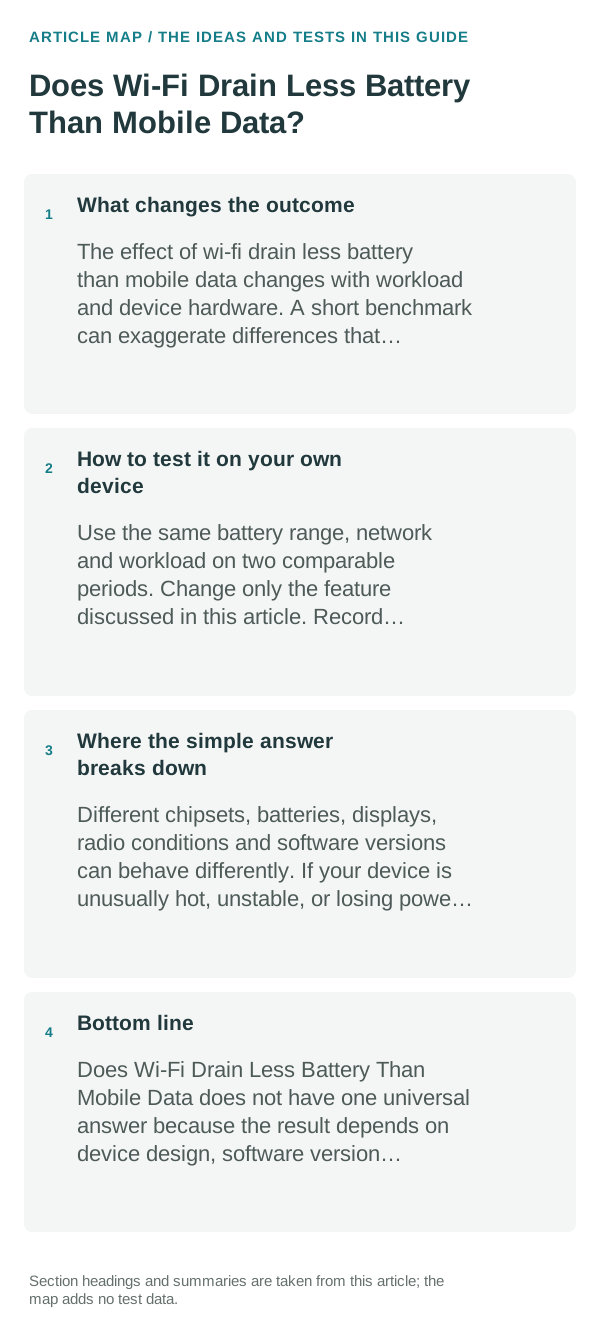
What changes the outcome
Compare both connections in the same place and check battery history; a weak cellular link can outweigh the Wi-Fi saving.
The sensible everyday approach
- Change only the setting directly related to wi-fi drain less battery than mobile data and observe the result.
- Use the device normally for long enough to see a pattern, not a five-minute snapshot.
- Prefer the platform’s built-in controls over third-party “optimizer” apps.
- Restore the original setting if the change makes the device less useful without a measurable benefit.
How to test it on your own device
Use the same battery range, network and workload on two comparable periods. Change only the feature discussed in this article. Record screen-on time, idle drain or the specific behavior you care about. One controlled comparison is more useful than several settings changed together.
Where the simple answer breaks down
Different chipsets, batteries, displays, radio conditions and software versions can behave differently. If your device is unusually hot, unstable, or losing power rapidly while idle, troubleshoot that underlying problem instead of treating wi-fi drain less battery than mobile data as the sole cause.
Bottom line
Use the connection with the steadier signal in your location. Compare both over the same kind of task before choosing a battery setting.
Separate battery use from battery-health guesses
Battery percentage is an estimate, so one sudden drop does not automatically prove the cell is damaged. Heat, weak signal, display time, background activity and a recent update can all change short-term drain.
Look at the device’s battery-usage screen over a meaningful window rather than judging from a few minutes. A single app dominating active or background use points to a different fix than high idle drain with the screen off.
Charging speed is also conditional: charger capability, cable quality, temperature, battery level and device limits all affect the rate. Test with known-good hardware before assuming the battery itself is the problem.
| What you observe | What it points to | Best next check |
|---|---|---|
| Drain mostly while screen is on | Display, radios or heavy foreground apps | Compare brightness, signal and active apps |
| Drain while idle | Background work, sync or poor signal | Check background usage and overnight conditions |
| Charging slows when warm or near full | Thermal or battery-protection behavior | Let the device cool and retest with known-good power gear |
Frequently asked questions
Is there one rule that applies to every phone?
No. Hardware, software, temperature, signal and workload can change the result.
What is the best way to test this?
Compare two similar periods while changing only one setting or behavior.
Should I install an optimizer app?
Usually not as a first step. Built-in battery and performance tools give cleaner evidence and avoid adding another background process.
Official sources and further reading
Repeat the same action after one change, and note the result.